
The National Institute of Standards and Technology (NIST) Special Publication (SP) 800-171 establishes security requirements for protecting Controlled Unclassified Information (CUI) in nonfederal systems and organizations.
For Department of Defense (DoD) contractors, these requirements play a critical role in safeguarding sensitive information and supporting Cybersecurity Maturity Model Certification (CMMC) Level 2 compliance.
With the release of NIST SP 800-171 Revision 3, organizations must understand how the updated requirements differ from Revision 2. The latest revision introduces changes to security requirements, control organization, terminology, and implementation guidance, with closer alignment to NIST SP 800-53 Revision 5. These updates may affect how contractors manage cybersecurity risks, document security practices, and demonstrate the effectiveness of their controls.
However, CMMC Level 2 currently remains based on NIST SP 800-171 Revision 2. Contractors should continue meeting existing compliance obligations while evaluating the potential impact of Revision 3. Understanding these differences now can help organizations identify future implementation needs, make informed security decisions, and prepare strategically without disrupting their current compliance efforts.
Why Did NIST Release Revision 3 of SP 800-171?
Cybersecurity threats continue to evolve, and the security requirements organizations rely on must keep pace. The National Institute of Standards and Technology (NIST) released SP 800-171 Revision 3 to modernize how organizations protect Controlled Unclassified Information (CUI) and better reflect today's cybersecurity challenges.
One of the primary reasons for the update was to strengthen alignment with NIST SP 800-53 Revision 5, which provides a broader catalog of security and privacy controls. This alignment helps establish greater consistency in security requirements, terminology, and control guidance, making it easier for organizations to understand the security outcomes they need to achieve.

Revision 3 also introduces changes intended to improve clarity and address areas that have become increasingly important to cybersecurity programs. These include supply chain risk management, security planning, and more clearly defined implementation expectations.
For Department of Defense (DoD) contractors, these updates highlight the importance of looking beyond individual security controls and understanding how people, processes, and technology work together to protect sensitive information.
However, understanding the purpose behind Revision 3 does not mean organizations need to immediately change their existing compliance programs. CMMC Level 2 continues to reference NIST SP 800-171 Revision 2, making it important to maintain current requirements while evaluating what the newer revision could mean for future cybersecurity planning.
NIST 800-171 Revision 2 vs. Revision 3: Key Differences at a Glance
While both revisions share the same goal of protecting Controlled Unclassified Information (CUI), the differences between NIST 800-171 Revision 2 and Revision 3 go beyond updated wording. Revision 3 reorganizes security requirements, introduces new areas of focus, and provides more detailed guidance on how organizations should implement and maintain effective security practices.
One of the most noticeable changes is the reduction from 110 security requirements in Revision 2 to 97 in Revision 3. However, fewer requirements do not necessarily mean less work. Some requirements have been consolidated, others revised or removed, and new requirements introduced to address evolving cybersecurity risks.
The table below highlights the key differences:
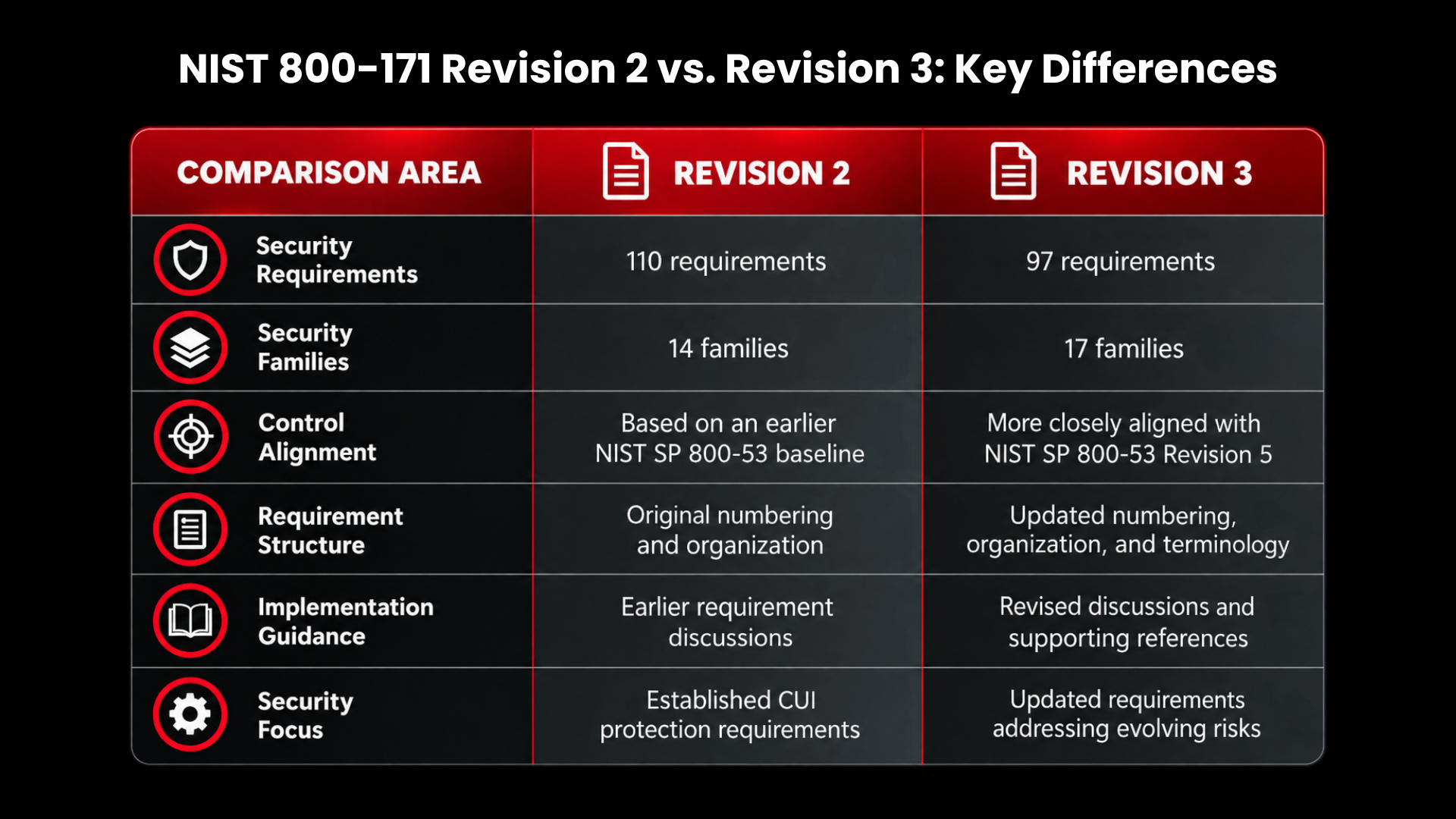
For Department of Defense (DoD) contractors, these changes make it important to look beyond the numbers. Understanding how individual requirements have changed can help organizations identify potential gaps, evaluate existing security controls, and plan for future adjustments.
The key takeaway is that Revision 3 represents a shift in how security requirements are organized and defined, not a reduction in the importance of protecting CUI.
What Are the Most Significant Security Requirement Changes in Revision 3?
Understanding the differences between NIST 800-171 Revision 2 and Revision 3 requires looking beyond the number of security requirements. While Revision 3 reduces the overall count, it also introduces new requirements, revises existing ones, and places greater emphasis on how organizations manage cybersecurity risks across their operations.
For Department of Defense (DoD) contractors, these changes could influence everything from security documentation and technical configurations to how responsibilities are assigned and maintained.
New Security Requirement Families
One of the most significant changes in NIST SP 800-171 Revision 3 is the addition of three security requirement families:
| Planning (PL): Establishes requirements for documenting security responsibilities, system boundaries, and how security protections are implemented. | |
| System and Services Acquisition (SA): Addresses security considerations when acquiring, developing, or maintaining systems and services. | |
| Supply Chain Risk Management (SR): Focuses on identifying and managing cybersecurity risks associated with suppliers, service providers, and other external dependencies. |
These additions reflect the importance of protecting CUI beyond an organization's internal systems, particularly when third parties support critical operations.
Revised and Consolidated Security Requirements
Revision 3 also reorganizes and updates several existing requirements to align more closely with NIST SP 800-53 Revision 5. Some requirements have been consolidated, while others include revised language or additional implementation expectations.
For organizations already meeting Revision 2 requirements, this means existing security controls may still provide a strong foundation. However, they should not assume that every control maps directly to its Revision 3 counterpart. A detailed comparison can help identify where additional safeguards, updated processes, or supporting documentation may be necessary.
Organization-Defined Parameters and Updated Guidance
Another important change is the formalization of organization-defined parameters (ODPs), which allow certain security requirements to specify values such as time periods, frequencies, or other implementation details.
 Rather than treating these parameters as simple configuration choices, organizations should understand who is responsible for defining them, how they are documented, and whether existing security practices support those decisions. Where applicable, values may also be established by an authorized external authority rather than selected independently.
Revision 3 also updates terminology and requirement discussions to provide greater consistency and clarity. These changes may affect how organizations describe their security controls, maintain System Security Plans (SSPs), and demonstrate that protections are operating as intended.
What These Changes Mean for DoD Contractors
The most important takeaway is that Revision 3 is not simply a renumbering exercise. It introduces changes that may require organizations to revisit technical safeguards, documentation, and operational responsibilities.
By understanding these updates now, contractors can identify potential areas for improvement while continuing to maintain their current CMMC Level 2 compliance requirements under Revision 2.
How Does Revision 3 Change Assessment Expectations and Documentation?
The changes introduced in NIST SP 800-171 Revision 3 go beyond security requirements. They also affect how organizations may need to demonstrate that their cybersecurity controls are properly implemented, documented, and maintained.
Alongside Revision 3, NIST published SP 800-171A Revision 3, which provides updated assessment procedures for evaluating the revised security requirements. These procedures help determine whether organizations have implemented the necessary protections for CUI.
For DoD contractors, understanding these differences is important when evaluating future assessment readiness.
Updated Assessment Procedures and Evidence Expectations
NIST SP 800-171A Revision 3 reflects the revised security requirements and introduces corresponding changes to assessment objectives. Depending on the requirement, organizations may need to demonstrate compliance through documentation reviews, personnel interviews, or technical testing.
This makes it important to evaluate whether existing evidence adequately demonstrates how security controls operate in practice, rather than simply confirming that a policy or procedure exists.
Documentation and Security Responsibilities
Revision 3 may also require organizations to revisit how they document security practices and assign responsibilities.
Key areas to evaluate include:
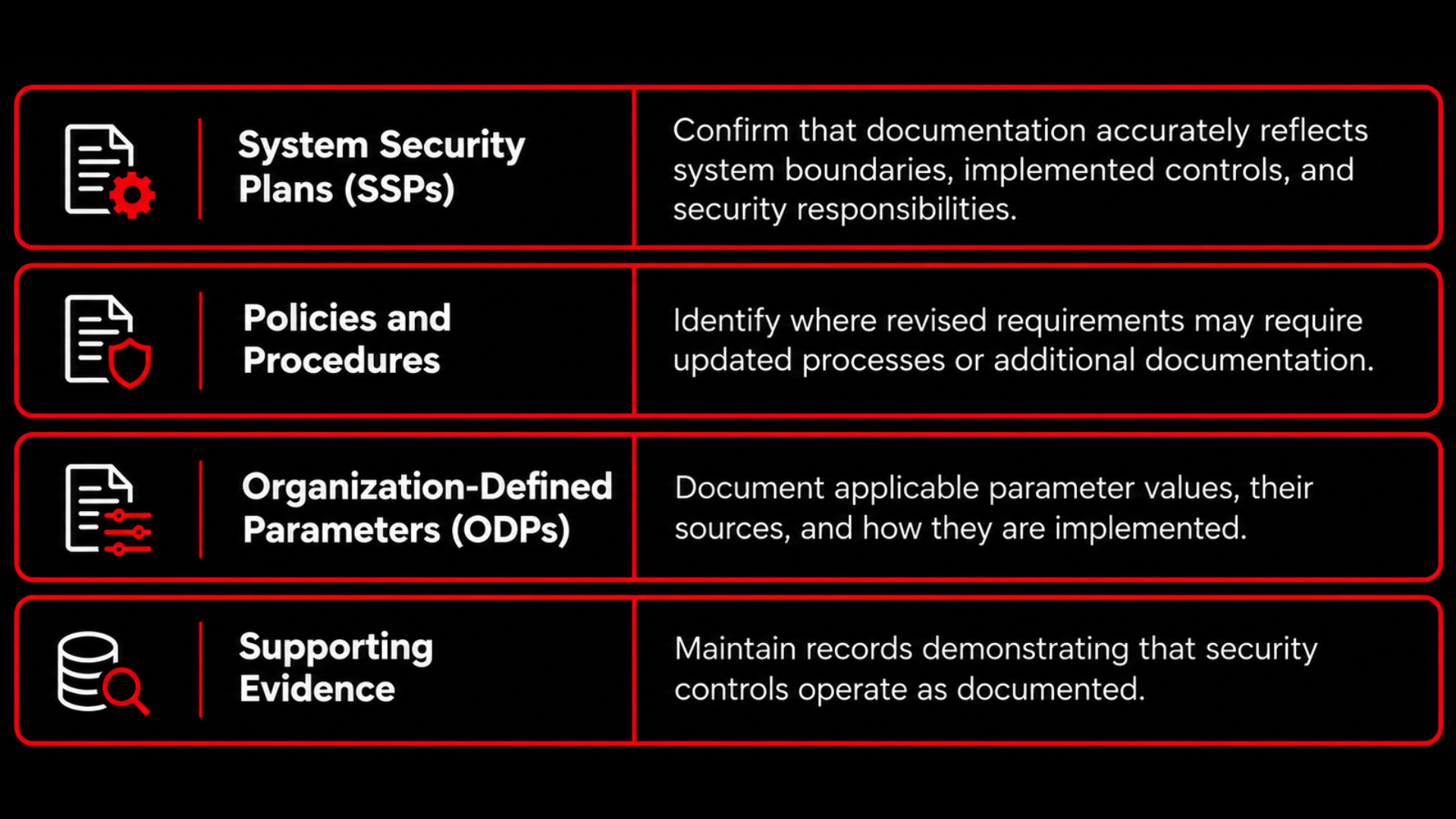
While these updates are important for future planning, current CMMC Level 2 assessments remain based on NIST SP 800-171 Revision 2 and its applicable assessment methodology. Contractors should continue maintaining evidence that supports existing requirements while evaluating how Revision 3 could affect future documentation and assessment preparation.
Which Revision 3 Changes May Require the Most Implementation Effort?
Understanding the differences between NIST 800-171 Revision 2 and Revision 3 is one thing. Determining how those changes could affect your existing cybersecurity program is another. For Department of Defense (DoD) contractors, the level of effort will depend on how well current security controls, documentation, and operational processes align with the updated requirements.
While some changes may involve updating policies or control mappings, others could require additional technical configurations, clearer responsibilities, or changes to how security activities are managed.
 |
Technical Controls and Security Configurations Revision 3 may require organizations to reevaluate existing security technologies and configurations, particularly in areas such as access management, system monitoring, and vulnerability management. |
 |
Supply Chain and External Service Provider Oversight The addition of Supply Chain Risk Management requirements places greater attention on how organizations identify and manage risks involving suppliers and external service providers. |

|
Documentation and Operational Processes Some of the most easily overlooked challenges involve how security practices are documented and maintained. Organizations may need to review:
The goal is not to overhaul an existing cybersecurity program prematurely. By identifying potential implementation challenges early, organizations can prioritize meaningful security improvements while continuing to meet current CMMC Level 2 requirements under Revision 2. |
Does CMMC Level 2 Require NIST 800-171 Revision 3?
With the release of NIST SP 800-171 Revision 3, many Department of Defense (DoD) contractors are asking an important question: Do they need to start implementing the updated requirements to maintain Cybersecurity Maturity Model Certification (CMMC) Level 2 compliance?
The answer is no. CMMC Level 2 currently remains based on NIST SP 800-171 Revision 2 and its 110 security requirements. Although Revision 3 introduces updated security requirements and guidance, its publication does not automatically change the compliance obligations established under the CMMC program.

For contractors, this distinction is important. Organizations should continue focusing on their existing contractual obligations, maintaining implemented security controls, and ensuring their documentation and supporting evidence accurately reflect their cybersecurity practices.
When Will Revision 3 Become a CMMC Requirement?
Any transition to Revision 3 as the CMMC Level 2 baseline would require formal regulatory action by the DoD. Until updated requirements are officially adopted and become applicable, contractors should not assume that Revision 3 has replaced the existing compliance framework.
However, waiting for a regulatory change before understanding the differences between NIST 800-171 Revision 2 and Revision 3 could make future planning more challenging.
Organizations can use this time to evaluate revised requirements, identify potential gaps, and consider how future changes might affect their cybersecurity programs.
The priority is to maintain current compliance while preparing strategically for what may come next. This approach allows contractors to make informed security decisions without prematurely changing their existing CMMC compliance efforts.
How Can Organizations Prepare for NIST 800-171 Revision 3?
Preparing for NIST SP 800-171 Revision 3 does not mean contractors need to overhaul their existing cybersecurity programs. Instead, organizations can take a practical, measured approach to understanding the updated requirements while continuing to meet their current Cybersecurity Maturity Model Certification (CMMC) Level 2 obligations.
The key is to identify where existing security practices already align with Revision 3 and where future adjustments may be necessary. Starting this evaluation early can help organizations make informed decisions without creating unnecessary compliance work or technology investments.
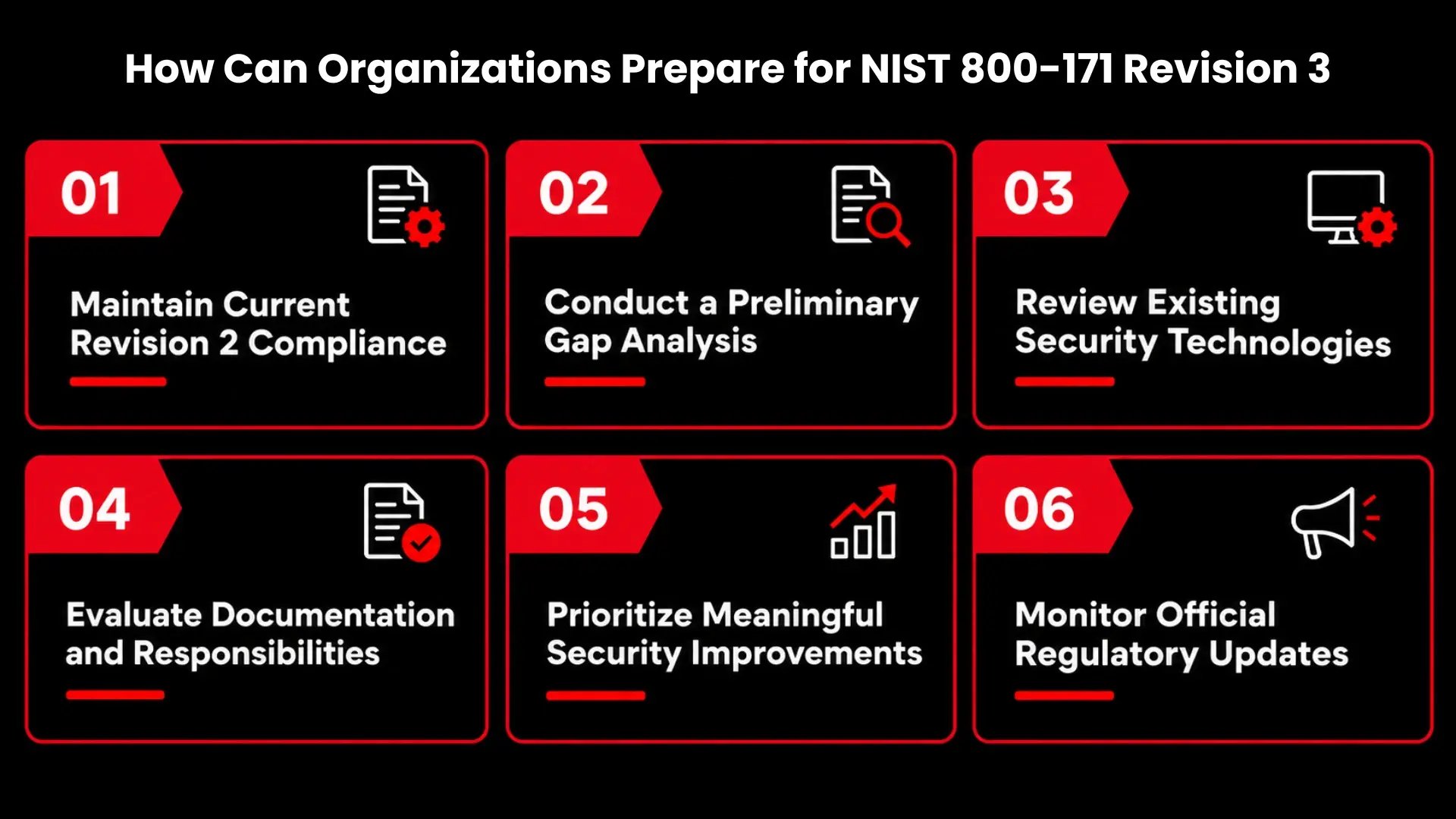
Here are six practical steps DoD contractors can take to prepare:
| Maintain Current Revision 2 Compliance: Continue implementing and maintaining the 110 security requirements under NIST SP 800-171 Revision 2, ensuring existing controls and supporting evidence remain accurate and effective. | |
| Conduct a Preliminary Gap Analysis: Compare Revision 2 and Revision 3 requirements to identify newly introduced, modified, or consolidated controls that may affect your cybersecurity program. | |
| Review Existing Security Technologies: Evaluate whether current tools, configurations, and monitoring capabilities can support updated requirements before considering additional solutions. | |
| Evaluate Documentation and Responsibilities: Review System Security Plans (SSPs), policies, procedures, and shared responsibility for documentation to identify areas that may require future updates. | |
| Prioritize Meaningful Security Improvements: Focus on improvements that strengthen cybersecurity today while supporting potential future requirements. Avoid making changes solely in anticipation of an unconfirmed compliance deadline. | |
| Monitor Official Regulatory Updates: Follow guidance from the Department of Defense (DoD) and the National Institute of Standards and Technology (NIST) to understand when changes may affect applicable requirements. |
Ultimately, preparing for NIST 800-171 Revision 3 is about building the security practices organizations already have in place. A thoughtful approach helps contractors reduce uncertainty, address potential gaps, and remain prepared for future changes without losing focus on current compliance responsibilities.
Preparing for Revision 3 While Maintaining CMMC Compliance
Understanding the differences between NIST 800-171 Revision 2 and Revision 3 is an important step toward maintaining a strong cybersecurity program. While Revision 3 introduces updated security requirements, expanded security families, and revised implementation guidance, organizations must remain focused on their current compliance responsibilities.
For Department of Defense (DoD) contractors, CMMC Level 2 continues to rely on NIST SP 800-171 Revision 2. Taking time to understand Revision 3 now can help identify potential gaps, strengthen existing security practices, and support more informed decisions as requirements evolve.
As a CMMC Registered Provider Organization (RPO) and experienced cybersecurity partner, MAD Security helps defense contractors navigate complex compliance requirements, evaluate security risks, and build practical strategies for long-term readiness.
Schedule a consultation with MAD Security today to strengthen your cybersecurity posture, maintain compliance, and prepare confidently for future requirements.
Frequently Asked Questions (FAQs)


