

Why the Proposed FAR CUI Rule Matters Beyond the DoD
The proposed Federal Acquisition Regulation (FAR) Controlled Unclassified Information (CUI) Rule has the potential to reshape how federal contractors protect sensitive government information. While many organizations currently associate Controlled Unclassified Information (CUI) safeguarding with Department of Defense (DoD) contracts under the Defense Federal Acquisition Regulation Supplement (DFARS), this proposal reaches much further. If finalized, it would establish a standardized baseline for CUI safeguarding requirements across nearly all federal executive agencies, creating greater consistency in how contractors protect sensitive information regardless of which agency they support.
For organizations that work with multiple federal customers, this represents a significant shift. Instead of navigating different agency-specific expectations for protecting CUI, contractors could be required to follow a more consistent set of cybersecurity and information protection requirements throughout the federal acquisition process. A standardized approach could simplify compliance efforts while strengthening the government's overall cybersecurity posture.
Equally important, the proposed FAR CUI Rule is currently open for public comment, giving contractors, industry associations, and other stakeholders an opportunity to help shape the final regulation. Organizations that review the proposal today can better understand how it may affect future contracts while providing practical feedback based on their operational experience.
Although the rule has not yet been finalized, it signals the federal government's continued commitment to strengthening CUI protection through consistent, government-wide cybersecurity requirements. For federal contractors, now is the time to understand what the proposal includes, evaluate its potential impact, and begin preparing for what could become the next evolution of federal cybersecurity compliance.
What Is the Proposed FAR CUI Rule?
The proposed FAR CUI Rule is intended to establish a consistent government-wide framework for protecting CUI that is created, received, processed, stored, transmitted, or shared during the performance of federal contracts. Rather than allowing agencies to rely on different acquisition requirements for safeguarding sensitive information, the proposal seeks to create a common baseline that can be applied more consistently across executive branch agencies.
 Because the FAR serves as the primary regulation governing how federal agencies acquire products and services, changes to its requirements often affect a much broader segment of the contracting community than agency-specific regulations. That is one reason this proposal has received considerable attention from contractors, compliance professionals, and cybersecurity leaders.
The proposal builds upon existing federal efforts to standardize CUI protection. It supports the objectives established by Executive Order 13556 and aligns with guidance from the National Archives and Records Administration (NARA), which oversees the government's CUI Program and establishes guidance for identifying, marking, handling, and safeguarding CUI throughout the federal government.
From a cybersecurity perspective, the proposal also reinforces the use of National Institute of Standards and Technology (NIST) Special Publication (SP) 800-171 as the foundational security standard for protecting CUI within nonfederal systems. Organizations that already comply with DFARS requirements will recognize many of the cybersecurity principles reflected in the proposal.
The key difference is the proposal's intended reach. If finalized, the FAR CUI Rule could establish standardized CUI safeguarding requirements for contractors supporting a wide range of federal civilian agencies, not just those performing work for the DoD. For many organizations, this could represent a significant expansion of cybersecurity and compliance expectations.
Why the Government is Moving Toward a Government-Wide CUI Standard
As federal agencies have increasingly relied on contractors to support critical missions, the volume of CUI shared outside the government has continued to grow. While the National Archives and Records Administration (NARA) established the government-wide CUI Program to create consistency in how sensitive information is identified and managed, agencies have historically implemented CUI safeguarding requirements through different contract clauses, policies, and acquisition practices. The result has been a fragmented compliance landscape that can be challenging for contractors to navigate.
For organizations that support multiple federal agencies, these inconsistencies often create unnecessary complexity. Contractors may encounter:
| Different CUI safeguarding requirements depending on the agency awarding the contract |
|
| Inconsistent contract clauses governing similar types of sensitive information | |
| Increased administrative effort to manage multiple compliance expectations | |
| Greater uncertainty about which cybersecurity requirements apply to specific contracts | |
| Duplicate documentation and reporting efforts across agencies |
These differences increase compliance costs, complicate internal cybersecurity programs, and make it more difficult for organizations to demonstrate that they are consistently protecting sensitive government information. Even when the objective remains the same, safeguarding CUI, varying agency requirements can create confusion and additional administrative burden.
 The proposed FAR CUI Rule seeks to address these challenges by establishing a standardized acquisition framework for protecting CUI across executive branch agencies. Rather than replacing agency-specific requirements where additional protections are necessary, the proposal would establish a common baseline that agencies can build upon when appropriate.
For contractors, this could provide greater consistency in cybersecurity expectations while reducing uncertainty across federal contracts.
More importantly, the proposal reflects the federal government's broader strategy to strengthen cybersecurity throughout the federal supply chain. By establishing a consistent approach to protecting CUI, agencies can improve collaboration, reduce ambiguity, and better protect sensitive information regardless of which federal organizations own the data.
Understanding why the government is pursuing this approach provides important context for the proposal itself. The next question contractors should consider is what the proposed safeguarding requirements include and how they may affect existing cybersecurity programs.
Proposed CUI Safeguarding Requirements Contractors Should Understand
Understanding why the federal government is pursuing a standardized approach is only part of the equation. Contractors should also understand what the proposed FAR CUI Rule expects organizations to do if the regulation is finalized.
Although the proposal may change following the public comment process, it provides a clear picture of how the federal government intends to strengthen the protection of CUI throughout the acquisition lifecycle. The emphasis is not simply on storing sensitive information securely. Instead, contractors are expected to establish cybersecurity practices that consistently protect CUI wherever it is created, processed, stored, transmitted, or shared.
The proposal also reinforces that protecting CUI is an organizational responsibility. Effective protection requires documented policies, technical safeguards, operational processes, and clear accountability across the organization.
While the final requirements may evolve, contractors should expect the proposal to address responsibilities such as:
| Protecting CUI throughout its lifecycle, from creation and receipt through storage, transmission, sharing, and secure disposal | |
| Implementing cybersecurity controls that reduce the risk of unauthorized access, disclosure, alteration, or destruction of CUI |
|
| Reporting cybersecurity incidents involving CUI in accordance with contractual and regulatory requirements | |
| Flowing down applicable safeguarding requirements to subcontractors and service providers that receive or process CUI | |
| Maintaining documentation that demonstrates how CUI is identified, protected, and managed throughout the organization | |
| Establishing clear ownership and accountability for protecting CUI through documented policies, procedures, and assigned responsibilities |
 Many of these expectations will already be familiar to organizations that comply with NIST SP 800-171 under DFARS requirements. Rather than introducing an entirely new cybersecurity model, the proposed rule builds upon an established framework that many defense contractors already use to protect sensitive government information.
For contractors that primarily support civilian agencies, however, the proposal could represent a significant change. Organizations that have not previously implemented cybersecurity controls aligned with NIST SP 800-171 may need to evaluate their existing security practices, identify gaps, and determine what improvements would be necessary if the rule is finalized.
Although no immediate action is required while the proposal remains under review, waiting until the final rule is issued could leave organizations with limited time to prepare. Using the public comment period to evaluate current cybersecurity practices can help organizations better understand their readiness and begin planning for potential future requirements.
As contractors assess these proposed responsibilities, many naturally ask how they compare with existing DFARS obligations. While there are similarities, the proposed FAR CUI Rule has a much broader scope.
Proposed FAR CUI Rule vs. DFARS: What's the Difference?
For organizations that already perform work for the DoD, many of the cybersecurity concepts in the proposed FAR CUI Rule will feel familiar. That is because both the proposal and DFARS recognize the importance of protecting CUI within contractor systems and reducing cybersecurity risk across the federal supply chain.
The most significant difference is not necessarily the cybersecurity controls themselves. It is who the requirements apply to.
DFARS primarily establishes cybersecurity requirements for contractors and subcontractors supporting the DoD. The proposed FAR CUI Rule, by comparison, is intended to establish a standardized baseline for protecting CUI across executive branch agencies. If finalized, organizations supporting civilian agencies could become subject to many of the same foundational cybersecurity expectations that defense contractors have been working toward for years.
The proposal is not intended to replace DFARS. Instead, it extends consistent CUI safeguarding expectations to a much broader portion of the federal contracting community while allowing agencies to include additional requirements when appropriate.
The following comparison highlights the key distinctions.
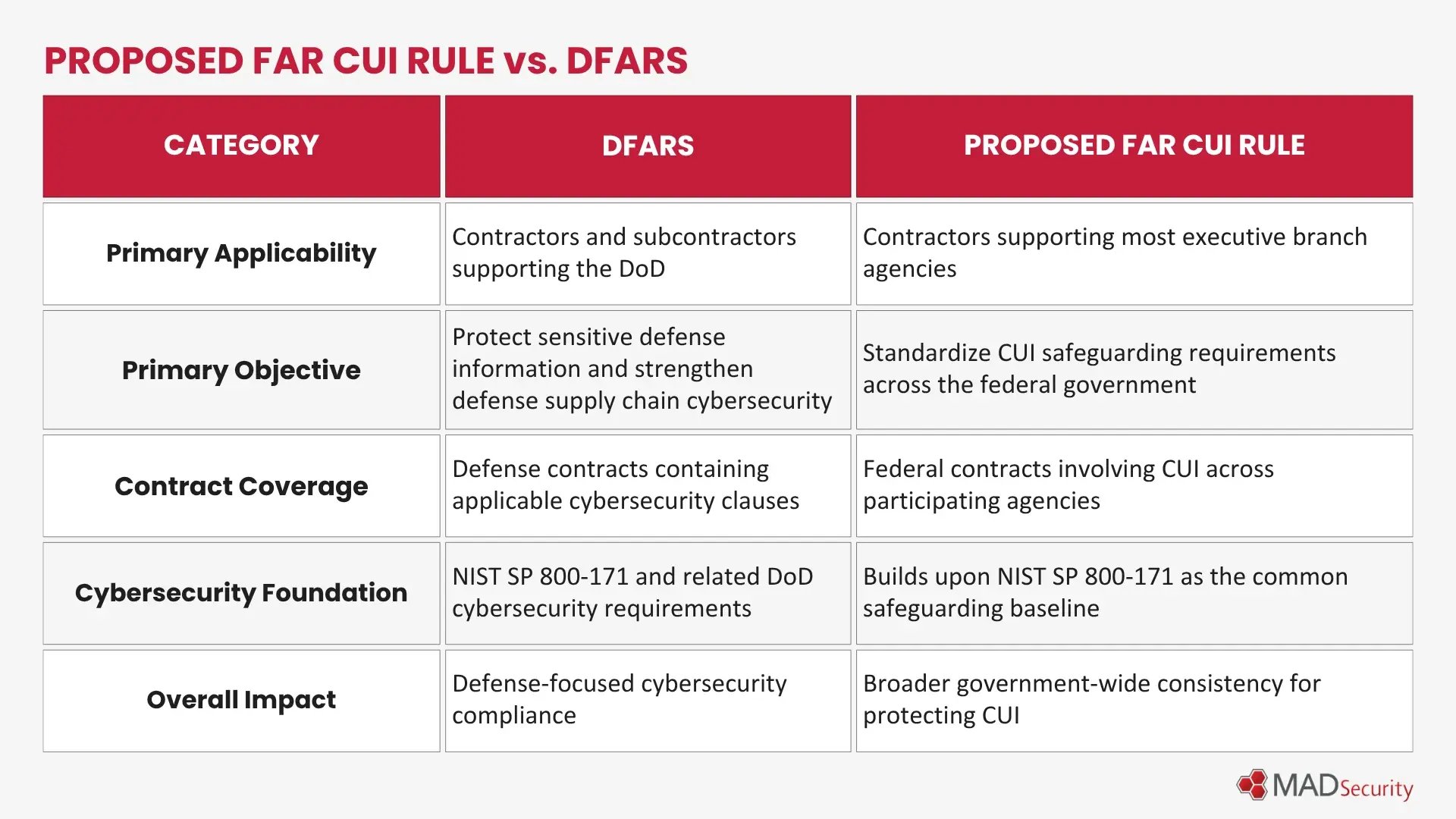
For defense contractors, the proposal largely reinforces a direction that has already been established through DFARS and CMMC. Many organizations have already invested in strengthening their cybersecurity programs, documenting security practices, and improving their ability to protect CUI.
For contractors that primarily support civilian agencies, the proposal could have a greater operational impact. Organizations that have not previously been required to align with these cybersecurity expectations may need to strengthen internal policies, improve technical safeguards, and develop more mature compliance processes.
Regardless of which federal agencies your organization supports today, understanding these differences is an important step in preparing future contracts. Equally important is recognizing that contractors still have an opportunity to influence the outcome by participating in the public comment process before the rule is finalized.
How Federal Contractors Can Submit Public Comments
One important point to remember is that the proposed FAR CUI Rule is not a final regulation. Before any new requirements become part of the FAR, the federal government is inviting contractors, industry associations, cybersecurity professionals, and other stakeholders to review the proposal and submit feedback through the public comment process.
Public comments are an important part of federal rulemaking because they help policymakers understand how proposed requirements may affect organizations of different sizes, industries, and operating environments. Feedback can identify implementation challenges, clarify technical language, and provide practical recommendations that improve the final regulation.
Organizations interested in participating should review the proposed rule and consider submitting comments before the public comment period closes. Effective comments are typically specific, constructive, and supported by operational experience or technical expertise. Rather than expressing general support or opposition, contractors should explain how particular provisions could affect implementation, contract performance, cybersecurity operations, or the protection of CUI.
Even if your organization does not intend to submit comments, reviewing the proposal is still a worthwhile exercise. Understanding the direction of the rule can help compliance leaders, cybersecurity teams, and contract managers begin evaluating how future CUI safeguarding requirements may affect existing policies, procedures, and security controls.
Whether you actively participate in the rulemaking process or simply monitor its progress, staying informed today will help your organization make more confident decisions as the proposal continues to evolve. More importantly, it provides an opportunity to begin preparing before new contractual requirements become effective.
What Federal Contractors Should Be Doing Now
.webp?width=300&height=169&name=Blog%20Post%20body%20images(11).webp) Although the proposed FAR CUI Rule has not yet been finalized, organizations should not wait until the final regulation is issued before evaluating their cybersecurity and compliance programs. The public comment period provides valuable time to understand the proposal, assess current capabilities, and identify areas that may require additional attention if standardized CUI safeguarding requirements are adopted.
Although the proposed FAR CUI Rule has not yet been finalized, organizations should not wait until the final regulation is issued before evaluating their cybersecurity and compliance programs. The public comment period provides valuable time to understand the proposal, assess current capabilities, and identify areas that may require additional attention if standardized CUI safeguarding requirements are adopted.
Rather than viewing preparation as a future project, contractors should begin evaluating how their existing practices compare with the direction outlined in the proposal.
Organizations should consider taking the following steps:
| Identify contracts that involve CUI. | |
| Determine where CUI is created, stored, processed, transmitted, and shared. | |
| Evaluate existing cybersecurity controls against NIST SP 800-171. | |
| Review policies, procedures, and documentation supporting CUI protection. | |
| Assess how subcontractors and third-party service providers handle CUI. | |
| Monitor updates throughout the federal rulemaking process and evaluate how changes could affect future compliance obligations. |
Taking these steps now allows organizations to better understand their current cybersecurity posture while reducing the likelihood of last-minute remediation efforts if the rule is finalized. Contractors that already have visibility into their CUI environment will be in a stronger position to adapt as new requirements emerge.
Preparation is not about assuming every provision in the proposed rule will remain unchanged. It is about recognizing the direction of federal cybersecurity policy and using this opportunity to build a stronger foundation for protecting sensitive government information.
As organizations strengthen their cybersecurity programs today, they also position themselves for the broader changes that may shape federal contracting in the years ahead.
How the Proposed Rule Could Shape Future Federal Contracting
Although the final language may change, the proposal provides valuable insight into the federal government's long-term cybersecurity strategy. Establishing more consistent safeguarding requirements across executive branch agencies has the potential to reshape how contractors prepare for, perform, and demonstrate compliance throughout the federal acquisition process.
If the proposed FAR CUI Rule is finalized, contractors may experience:
| More consistent CUI safeguarding requirements across participating federal agencies. | |
| Greater emphasis on documented cybersecurity policies, procedures, and evidence. | |
| Increased expectations for managing cybersecurity risks throughout the supply chain. | |
| Broader adoption of security practices aligned with NIST SP 800-171. | |
| More consistent cybersecurity expectations during contract performance and future assessments. |
For many organizations, these changes may simplify compliance by reducing the differences between agency-specific acquisition requirements. A more standardized framework can make it easier to establish repeatable cybersecurity processes while improving consistency across multiple federal contracts.
The proposal also reinforces the growing importance of supply chain cybersecurity. Prime contractors may increasingly evaluate whether subcontractors and service providers have appropriate safeguards in place before sharing CUI. As cybersecurity expectations continue to mature, organizations that proactively strengthen their security programs may be better positioned to compete for future federal opportunities.
While the proposed rule is still under review, its overall direction is clear. Cybersecurity continues to become a more significant consideration in federal contracting, and contractors that prepare early will likely be better positioned to adapt as requirements evolve.
Prepare Today for Tomorrow's Federal Cybersecurity Requirements
The proposed FAR CUI Rule represents an important step toward establishing a more consistent approach to protecting CUI across the federal government. Although the proposal is still open for public comment and may change before becoming final, it clearly reflects the government's continued commitment to strengthening cybersecurity throughout the federal supply chain.
.webp?width=300&height=169&name=Blog%20Post%20body%20images(13).webp) For federal contractors, this is an opportunity to do more than simply monitor regulatory developments. Reviewing the proposal, understanding how it compares with existing requirements, and evaluating your organization's current cybersecurity practices can help you prepare for potential changes before they become contractual obligations.
For federal contractors, this is an opportunity to do more than simply monitor regulatory developments. Reviewing the proposal, understanding how it compares with existing requirements, and evaluating your organization's current cybersecurity practices can help you prepare for potential changes before they become contractual obligations.
Organizations that already protect CUI under DFARS may find many of the proposed concepts familiar. Contractors supporting civilian agencies, however, should pay close attention to the proposal's broader scope and consider how standardized safeguarding requirements could affect future contracts, cybersecurity programs, and compliance planning.
At MAD Security, the team works with federal contractors every day to strengthen cybersecurity programs, protect CUI, and prepare for evolving compliance requirements. Whether your organization is improving its alignment with NIST SP 800-171, preparing for CMMC, or evaluating the potential impact of emerging federal regulations, taking a proactive approach can help reduce risk and improve long-term readiness.
The proposed FAR CUI Rule has not yet been finalized, but the direction is clear. Organizations that begin preparing today will be in a stronger position to respond confidently as federal cybersecurity requirements continue to evolve.
Frequently Asked Questions (FAQs)


