

Why This Distinction Matters for CMMC Level 2
Organizations preparing for Cybersecurity Maturity Model Certification (CMMC) Level 2 often encounter confusion surrounding the term "Plan of Action." Specifically, many assume that a Plan of Action and Milestones (POA&M) satisfies the requirements of NIST Special Publication (SP) 800-171 control 3.12.2.
 While the names sound similar, they serve different purposes. A POA&M is primarily used to document security requirements that have not yet been fully implemented and to track progress toward compliance. Control 3.12.2, however, focuses on an organization's ability to identify, prioritize, and remediate vulnerabilities through a structured and repeatable process.
Understanding the distinction is important. One demonstrates how your organization addresses implementation gaps. The other demonstrates how your organization manages and reduces risk over time. Treating them as interchangeable can create compliance challenges.
What Is a POA&M in a CMMC Environment?
 A Plan of Action and Milestones (POA&M) is a management tool used to document and track deficiencies related to security control implementation. Within a CMMC environment, it helps organizations identify which requirements have not yet been fully satisfied and establish a roadmap for addressing those gaps.
The POA&M provides visibility into outstanding compliance work and allows stakeholders to monitor remediation progress. Rather than proving a requirement has been met, it documents the actions necessary to achieve compliance.
What a POA&M Typically Includes
Most POA&Ms contain:
| Unmet security requirements | |
| Specific implementation deficiencies |
|
| Planned corrective actions |
|
| Assigned ownership |
|
| Target completion dates | |
| Status updates and progress tracking |
At its core, a POA&M answers a simple question:
Which security requirements have not been fully implemented, and what is the organization's plan to address them?
For example, if multifactor authentication has not yet been deployed for all privileged accounts, the POA&M would document the deficiency, assign responsibility, identify remediation steps, and establish a completion timeline.
How Organizations Commonly Use POA&Ms
Organizations frequently use POA&Ms to:
| Track implementation progress | |
| Manage allowable deficiencies when applicable |
|
| Coordinate remediation activities across teams |
|
| Assigned ownership |
|
| Document progress toward meeting security requirements |
In this context, the POA&M serves as a compliance-focused tracking mechanism. Its primary purpose is to help the organization achieve implementation objectives and demonstrate progress toward meeting required controls.
While a POA&M helps manage implementation gaps, it does not fully address the intent behind NIST SP 800-171 requirement 3.12.2. To understand why, it is important to examine what the requirement is designed to accomplish.
Understanding the Intent of CMMC Control 3.12.2
Control 3.12.2 requires organizations to develop and implement plans of action designed to correct deficiencies and reduce vulnerabilities in organizational systems.
 Unlike a POA&M, this requirement is not limited to tracking incomplete control implementation. Instead, it focuses on an organization's ability to continuously identify security weaknesses, prioritize remediation efforts, and reduce risk across its environment.
Why Control 3.12.2 Exists
Security programs do not end once controls have been implemented. New vulnerabilities emerge, technology changes, and threat actors continually adapt their tactics. Organizations need a formal process for responding to these evolving risks.
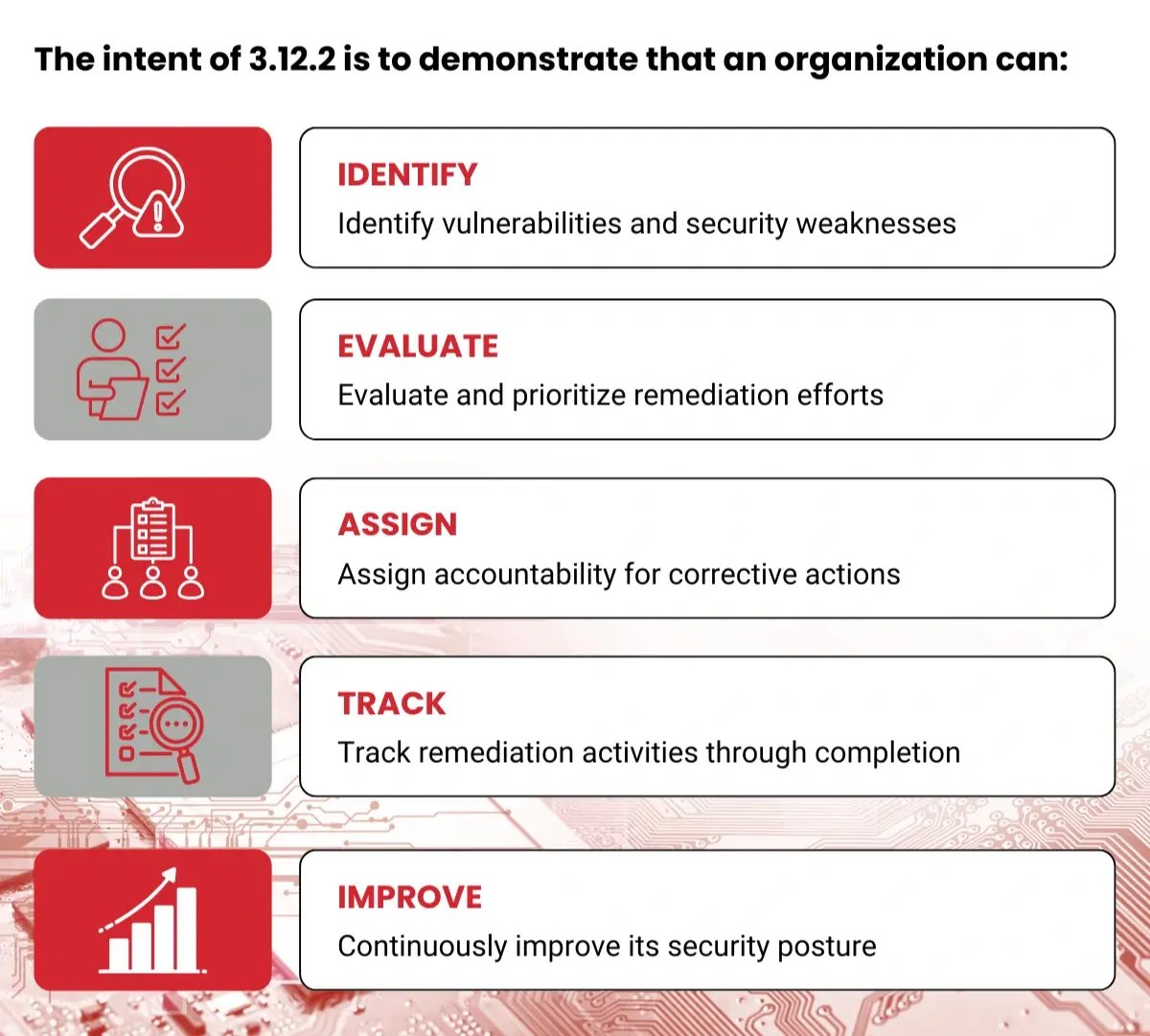
This requirement reflects an ongoing operational capability rather than a one-time compliance exercise.
The Question Control 3.12.2 Answers
While a POA&M focuses on how an organization plans to complete unmet requirements, control 3.12.2 addresses a different objective:
How does the organization systematically identify, prioritize, and remediate vulnerabilities and security weaknesses?
POA&M vs. Plan of Action for 3.12.2: The Key Differences
Although both involve remediation activities, their purpose, scope, and assessment expectations are significantly different.
A POA&M Is Compliance-Focused
A POA&M is designed to document implementation gaps against security requirements. It tracks the work necessary to achieve compliance and measures progress toward satisfying specific control objectives.
Organizations typically create POA&Ms when they discover that a required control has not been fully implemented or when remediation activities are necessary to address implementation deficiencies.
A Plan of Action Under 3.12.2 Is Risk-Focused
The Plan of Action required by 3.12.2 addresses vulnerabilities and weaknesses that create risk to the organization, regardless of whether security controls have already been implemented.
For example, a vulnerability scan may identify a critical software flaw that requires immediate remediation. The related security controls may already be operating as intended, yet the organization must still have a process for evaluating the issue, assigning ownership, tracking remediation, and validating resolution.
Common Inputs to a 3.12.2 Plan of Action
Plans of Action under 3.12.2 are often driven by findings from:
| Vulnerability assessments | |
| Risk assessments |
|
| Security incidents | |
| Continuous monitoring activities | |
| Internal reviews | |
| Threat intelligence |
These activities identify risks that require action even when implementation requirements have already been met.
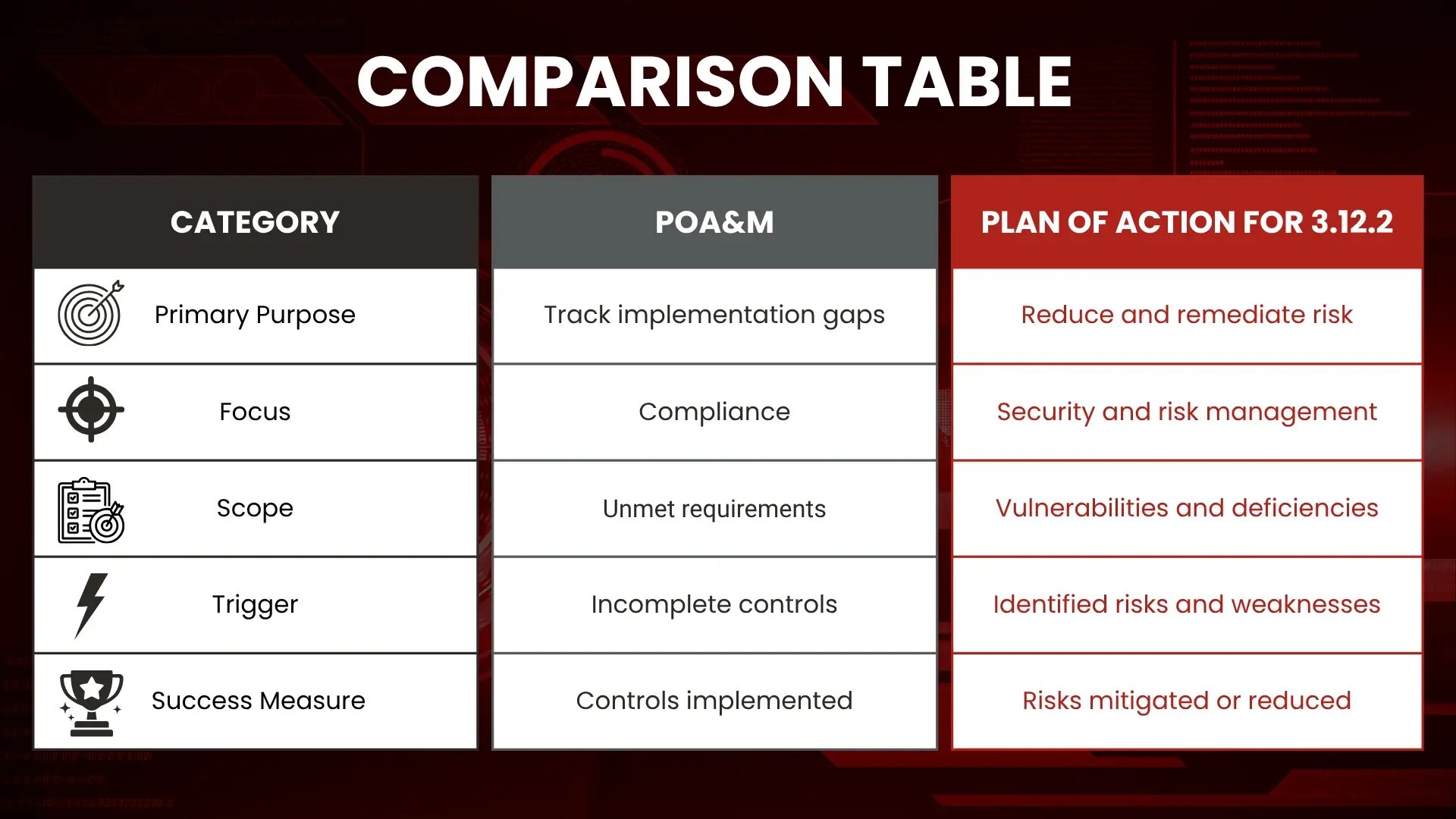
The distinction is straightforward: a POA&M documents the path toward meeting requirements, while the Plan of Action required by 3.12.2 demonstrates how an organization continuously addresses vulnerabilities and manages risk after those requirements have been implemented.
Need Help Demonstrating Compliance with CMMC 3.12.2?
A POA&M can help track implementation gaps, but demonstrating compliance with control 3.12.2 requires a mature process for managing and reducing risk. MAD Security helps defense contractors develop effective remediation processes and improve vulnerability management through its CMMC Consulting Services, Virtual Compliance Management, and Vulnerability Management Services.
Frequently Asked Questions (FAQs)


