
Preparing for a Cybersecurity Maturity Model Certification (CMMC) assessment involves more than implementing security controls. Organizations must also demonstrate that those controls are functioning as intended and consistently operating as documented. Yet many defense contractors wait until a gap assessment, mock assessment, or CMMC certification assessment is approaching before they begin gathering supporting evidence.
This last-minute approach can create unnecessary challenges. Screenshots may no longer reflect current configurations; security logs may have expired, incident tickets may be incomplete, and important documentation may be scattered across different systems or teams. Even when security controls are properly implemented, missing or outdated evidence can make it difficult to demonstrate compliance with CMMC Level 2 requirements.
A repeatable CMMC evidence collection process helps organizations avoid these challenges. By regularly collecting, organizing, and validating evidence, defense contractors can maintain accurate records that reflect their current security environment. Rather than scrambling to locate documentation before an assessment, organizations can build evidence collection into everyday cybersecurity operations and approach CMMC assessment readiness with greater confidence.
Why Evidence Collection Matters for CMMC Level 2 Compliance
Meeting Cybersecurity Maturity Model Certification (CMMC) Level 2 requirements involves more than having security policies, procedures, and technical controls in place. Organizations must also provide credible evidence demonstrating that these controls are properly implemented and operating as intended.
During a CMMC assessment, assessors use three primary methods to evaluate security control implementation:
| Examine: Review policies, procedures, system configurations, security logs, and other supporting documentation. | |
| Interview: Speak with personnel responsible for implementing, managing, and maintaining security controls. | |
| Test: Evaluate technical mechanisms and processes to determine whether controls function as documented. |
These methods help assessors determine whether an organization's security practices align with applicable National Institute of Standards and Technology (NIST) Special Publication (SP) 800-171 requirements.
 However, even organizations with established cybersecurity practices can encounter challenges when supporting evidence is incomplete, outdated, or difficult to retrieve. Missing access reviews, inconsistent documentation, or configuration records that no longer reflect the current environment can complicate the assessment process.
Effective CMMC evidence collection helps bridge the gap between implementing security controls and demonstrating their effectiveness. By maintaining accurate, accessible, and verifiable records, organizations can strengthen accountability, identify documentation gaps earlier, and support ongoing CMMC assessment readiness.
What Is a Repeatable CMMC Evidence Collection Process?
A repeatable CMMC evidence collection process is a structured approach to consistently gathering, organizing, maintaining, and reviewing documentation that demonstrates how an organization implements its security controls. Rather than collecting evidence only when an assessment approaches, organizations establish a routine that keeps supporting records accurate, accessible, and aligned with their current cybersecurity practices.
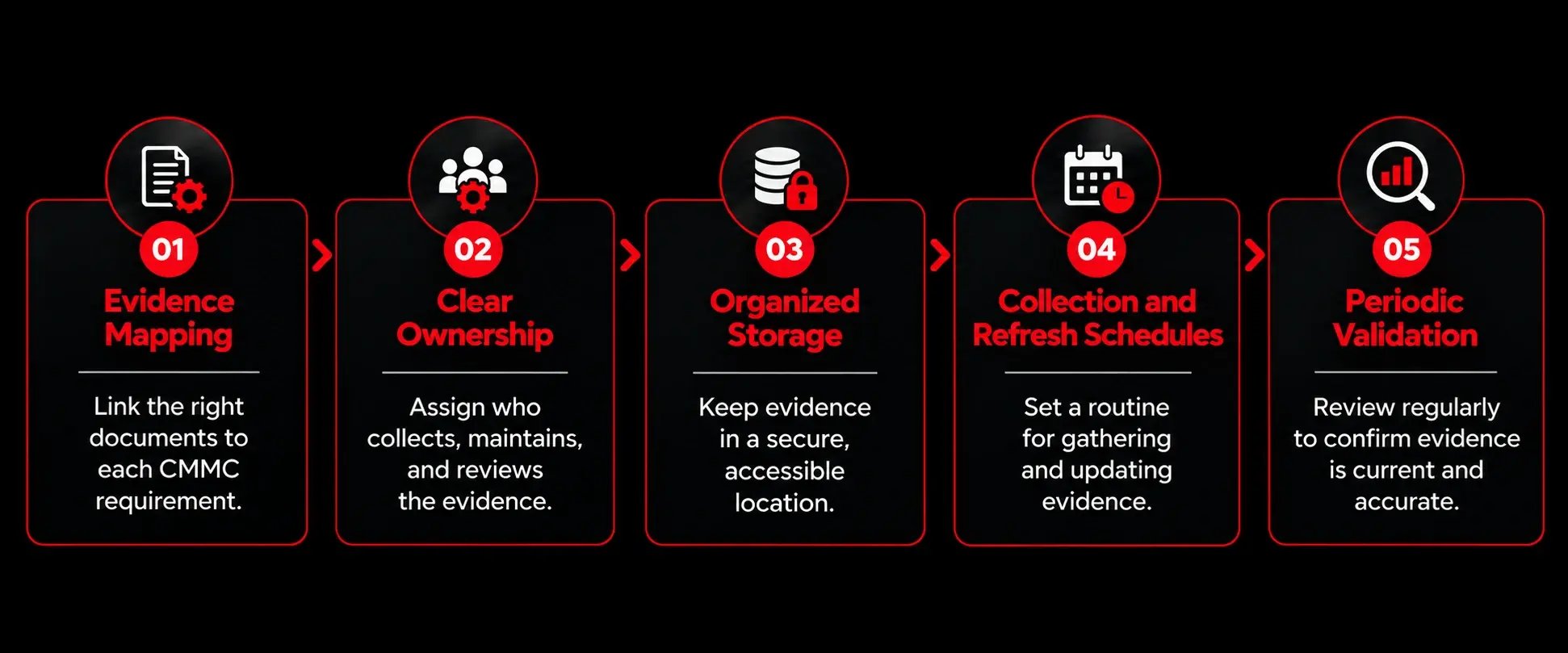
An effective process typically includes several essential components:
| Evidence Mapping: Identify which documents, records, and technical artifacts support each applicable CMMC requirement and assessment objective. | |
| Clear Ownership: Assign responsibility for collecting, maintaining, and reviewing evidence across relevant teams and service providers. | |
| Organized Storage: Maintain evidence in secure, accessible locations with consistent naming conventions and version control. | |
| Collection and Refresh Schedules: Establish appropriate timelines for gathering and updating evidence based on operational needs. | |
| Periodic Validation: Review artifacts regularly to confirm they accurately reflect current systems, configurations, and security practices. |
By integrating these activities into everyday cybersecurity operations, organizations can reduce documentation inconsistencies, improve accountability, and identify potential evidence gaps earlier.
The goal is not simply to collect more documentation. It is to maintain reliable evidence that supports ongoing security oversight and demonstrates how controls operate in practice.
How to Build a Repeatable CMMC Evidence Collection Process
Building a reliable CMMC evidence collection process does not have to mean adding another complicated layer to your compliance program. The key is to establish clear responsibilities, consistent documentation practices, and a routine for keeping evidence current. When these activities become part of everyday security operations, organizations can spend less time searching for records and more time ensuring their controls are working as intended.
Here are six practical steps to help establish a repeatable process.
 |
Map Evidence to CMMC Requirements Start by identifying the documentation and technical artifacts that support each applicable CMMC Level 2 requirement and assessment objective. This may include security policies, system configurations, access reviews, monitoring logs, and incident response records. Connect these artifacts to your System Security Plan (SSP) so there is a clear relationship between documented security practices and the evidence supporting their implementation. |
 |
Assign Clear Evidence Ownership Every evidence category should have a designated owner responsible for collecting, maintaining, and reviewing its supporting records. Define responsibilities across IT, cybersecurity, compliance, and leadership teams. If your organization works with a Managed Service Provider (MSP), Managed Security Service Provider (MSSP), or other external service provider, clarify which evidence each party is responsible for maintaining and providing. |
 |
Establish a Secure, Organized Evidence Repository Evidence should be easy for authorized personnel to locate without compromising sensitive information.
Use consistent naming conventions, logical folder structures, access restrictions, and version control. Organize records by CMMC requirement, assessment objective, or security control family, depending on what works best for your environment. |

|
Define Evidence Collection and Refresh Schedules Not all evidence needs to be collected or updated at the same frequency. Security logs may require frequent collection, while training records or access reviews may be updated according to established schedules or specific events.
Set realistic collection intervals based on operational needs, applicable requirements, and system changes. Incorporating these activities into existing workflows helps prevent evidence collection from becoming an additional last-minute responsibility. |
|
Review and Validate Evidence Regularly Collecting evidence is only useful when the information remains accurate and relevant.
Periodically review artifacts to confirm they reflect current configurations, security practices, and documented procedures. Pay particular attention to changes involving systems, personnel, access permissions, or service providers that could affect previously collected evidence. |

|
Track and Address Evidence Gaps When evidence is missing, outdated, or incomplete, document the issue and assign responsibility for resolving it.
Track corrective actions, establish reasonable completion dates, and verify that updated evidence addresses the identified gap. This helps prevent the same documentation problems from resurfacing during future readiness activities. |

A repeatable CMMC evidence collection process works best when it becomes part of how your organization manages cybersecurity every day. With clear ownership, organized records, and consistent validation, your team can maintain stronger visibility into security control implementation while reducing the burden of CMMC assessment preparation.
Common Types of CMMC Evidence Organizations Should Maintain
Once your organization has established a consistent collection process, the next step is understanding which records need to be maintained. CMMC Level 2 evidence can come from multiple systems, teams, and security activities, making it important to identify the artifacts that demonstrate how your controls operate in practice.
While the specific evidence needed depends on the applicable security requirements and assessment objectives, common examples include:
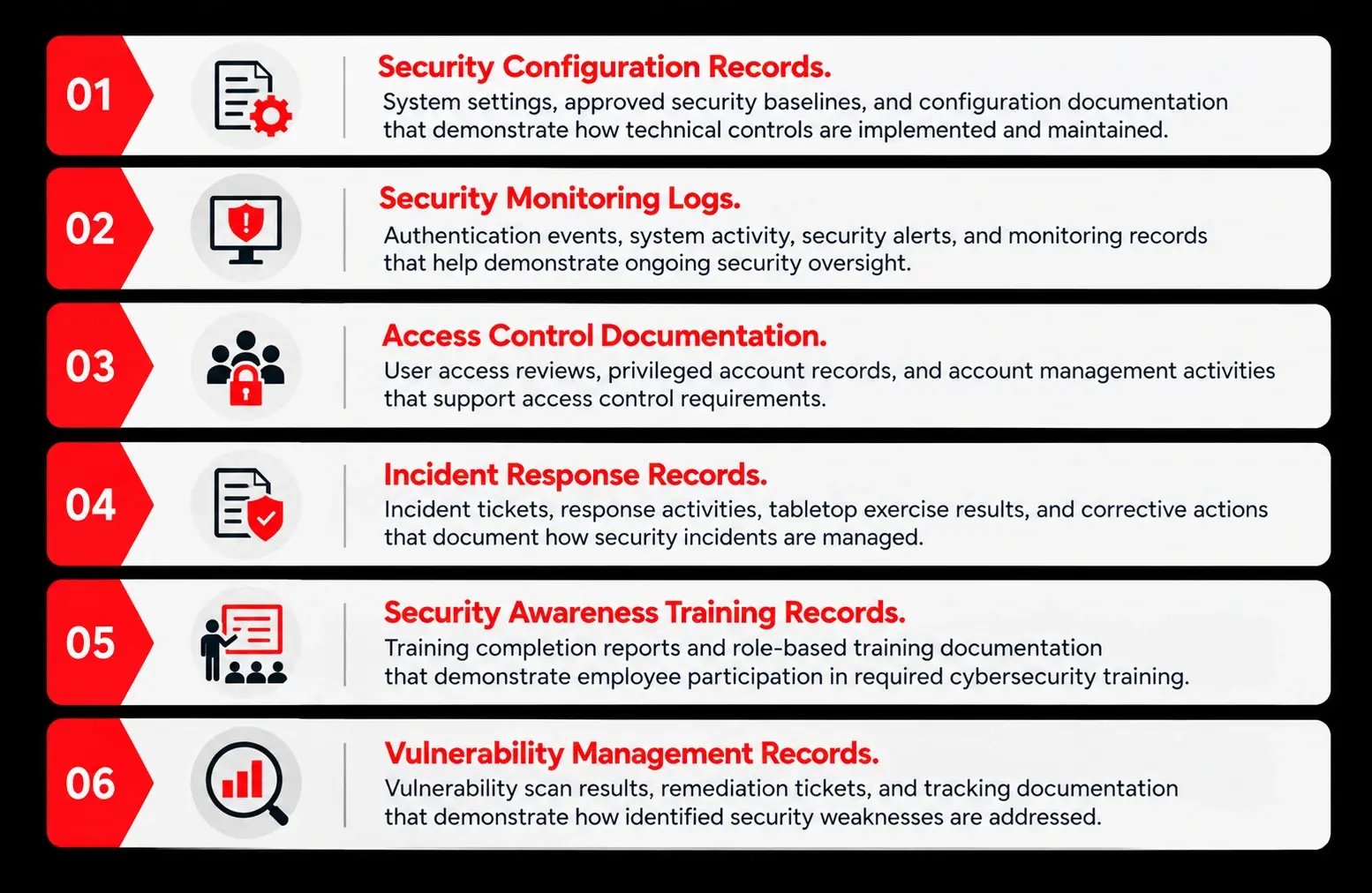
Different evidence types require different collection schedules and retention practices. For example, security logs may need to be preserved regularly to prevent data loss, while access reviews and training records may be updated following scheduled activities or relevant changes.
The goal is to maintain evidence that is accurate, relevant, and readily available when needed. A well-organized collection process also makes it easier to recognize when records need to be refreshed as your security environment evolves.
Keeping CMMC Evidence Accurate as Your Environment Changes
 Collecting and organizing evidence is an important part of CMMC assessment readiness, but maintaining its accuracy is just as critical. Your cybersecurity environment is constantly evolving, and evidence that was valid a few months ago may no longer reflect how your security controls operate today.
System upgrades, configuration changes, and new technologies can affect previously collected documentation. Without regular reviews, organizations risk relying on outdated records that no longer align with their actual security practices or System Security Plan (SSP).
Certain operational changes should trigger a review of existing CMMC evidence, including:
| System and Infrastructure Changes: Network modifications, cloud migrations, and updates to systems handling Controlled Unclassified Information (CUI). | |
| Security Configuration Updates: Changes to access controls, monitoring tools, security settings, or technical safeguards. | |
| Personnel and Access Changes: Employee departures, role changes, and modifications to privileged access permissions. | |
| Service Provider Changes: New vendors, updated service agreements, or changes in shared security responsibilities. | |
| Policy and Procedure Updates: Revisions to documented security practices that affect how controls are implemented or maintained. |
Incorporating evidence validation into existing change management and compliance review activities helps ensure documentation remains consistent with actual operations.
Maintaining accurate CMMC evidence is an ongoing responsibility, not a one-time task. Regular reviews help organizations identify inconsistencies early, keep supporting records relevant, and strengthen confidence in their overall assessment readiness.
Common CMMC Evidence Collection Mistakes to Avoid
Even with established cybersecurity controls, organizations can encounter challenges when their evidence collection practices are inconsistent. These issues often become more noticeable during CMMC assessment preparation, when teams must locate records, verify their accuracy, and demonstrate how security requirements are being met.
Some of the most common CMMC evidence collection mistakes include:
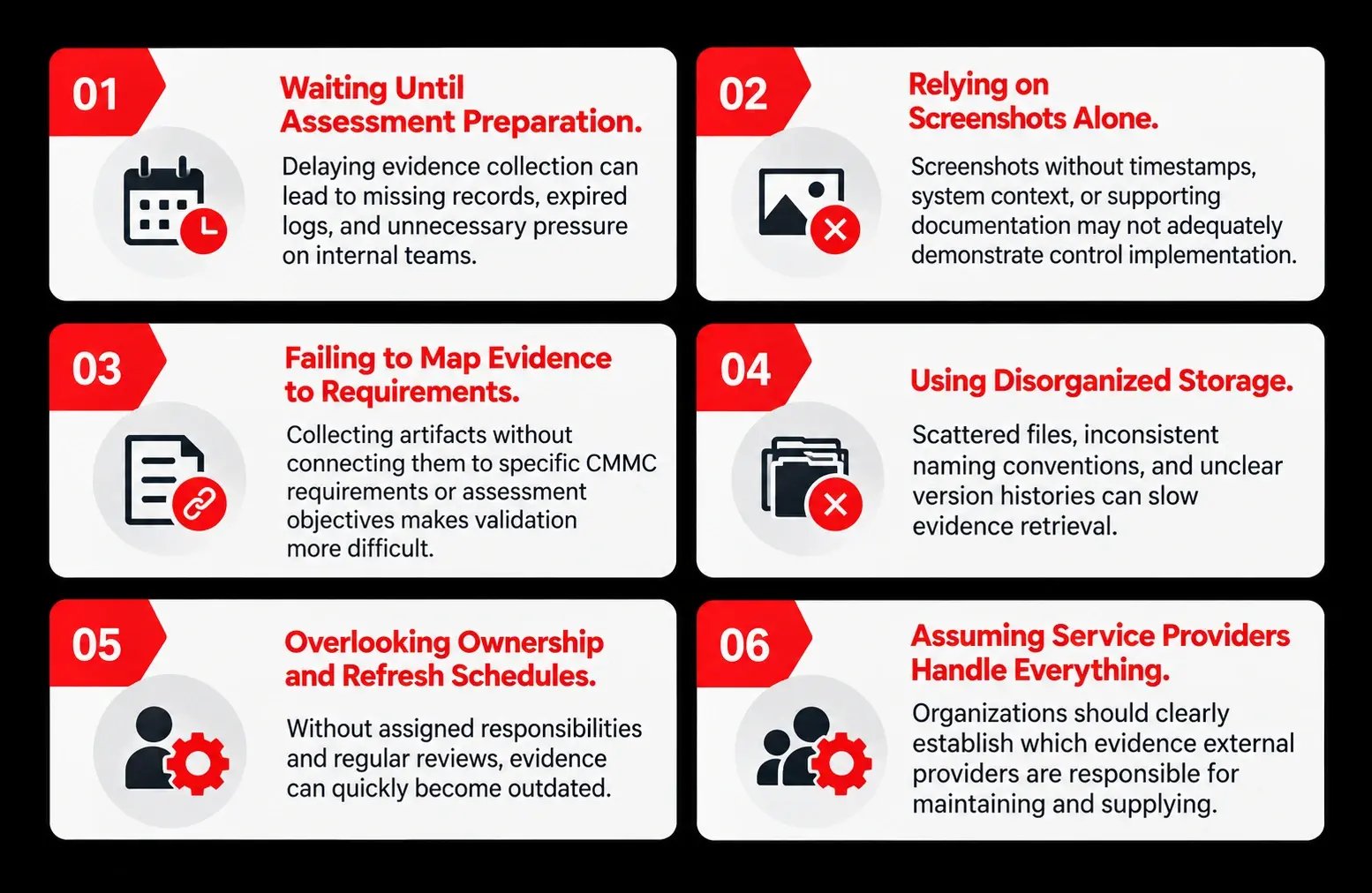
Avoiding these mistakes requires more than better document organization. A reliable CMMC evidence collection process depends on clear accountability, consistent validation, and documentation that accurately reflects current security operations.
Addressing these issues early helps organizations reduce evidence gaps and maintain stronger CMMC assessment readiness.
How Repeatable Evidence Collection Supports Ongoing CMMC Readiness
A consistent CMMC evidence collection process does more than simplify assessment preparation. It helps organizations maintain visibility into their cybersecurity practices, identify potential gaps earlier, and strengthen accountability across teams responsible for implementing and maintaining security controls.
When evidence collection becomes part of routine operations, organizations can spend less time searching for documentation and more time evaluating whether their security measures continue to function as intended.
A repeatable process provides several practical benefits:
| Simplifies Assessment Preparation: Reduces the time and effort required to gather supporting documentation for gap assessments, mock assessments, and certification assessments. | |
| Improves Security Visibility: Helps teams verify that implemented controls align with documented policies, procedures, and technical configurations. | |
| Strengthens Accountability: Establishes clearer responsibilities for maintaining evidence across internal teams and external service providers. | |
| Identifies Gaps Earlier: Makes it easier to recognize missing records, outdated documentation, or inconsistencies before they create assessment challenges. | |
| Supports Continuous Compliance: Encourages regular oversight and ongoing validation of security practices as systems and operational requirements evolve. |
However, maintaining organized evidence does not automatically establish CMMC compliance. The underlying security controls must also be properly implemented and operating effectively.
By connecting evidence management with everyday cybersecurity activities, organizations can build a more sustainable approach to CMMC assessment readiness while reducing unnecessary preparation challenges.
How MAD Security Helps Organizations Strengthen CMMC Evidence Readiness
Building and maintaining a reliable CMMC evidence collection process can be challenging, especially when your organization manages multiple systems, security controls, and external service providers. Having the right cybersecurity and compliance partner can help simplify these responsibilities and ensure evidence collection supports your broader security objectives.
As a CMMC Registered Provider Organization (RPO) and CMMC Level 2 Certified Managed Security Services Provider, MAD Security helps Defense Industrial Base contractors strengthen their cybersecurity practices and prepare for CMMC assessments with greater confidence.
 Through gap assessments, mock assessments, and compliance consulting, MAD Security helps organizations identify documentation gaps, map evidence to applicable security requirements, and improve System Security Plan (SSP) accuracy. Its managed security services and ongoing monitoring capabilities also support consistent security operations and the availability of relevant technical evidence.
The goal is not simply to prepare for an assessment. It is to build sustainable security and compliance practices that keep your organization informed, accountable, and prepared as your environment evolves.
Make CMMC Evidence Collection Part of Everyday Operations
Effective CMMC evidence collection should not begin when an assessment is approaching. It should be part of how your organization manages cybersecurity every day. Waiting until the last minute to gather documentation can create unnecessary challenges, especially when critical records are missing, outdated, or difficult to retrieve.
By mapping evidence to CMMC requirements, assigning clear ownership, maintaining secure storage, and establishing regular collection and review schedules, organizations can build a more reliable and sustainable process. These practices help ensure supporting documentation remains accurate, accessible, and aligned with actual security operations.
Strong CMMC assessment readiness starts with consistent security practices and reliable evidence.
MAD Security helps defense contractors identify evidence gaps, strengthen compliance documentation, and improve assessment preparation.
Schedule a consultation with MAD Security TODAY to strengthen your CMMC evidence collection process and build lasting assessment readiness.
Frequently Asked Questions (FAQs)


