
Watch the October Maritime VBlog
Most maritime leaders eventually ask us some version of the same question:
Are we good enough?
It is a fair question. Executives and board members are responsible for making sure the organization is managing risk appropriately, but cybersecurity can make that difficult to judge. There is always another threat, another vulnerability, another technology, and another recommendation competing for attention and budget.
So, what does “good” actually look like when it comes to maritime cybersecurity?
It does not mean eliminating every vulnerability or preventing every possible cyber incident. It means building a maritime cybersecurity program that includes visibility of your systems, consistently understanding risk, assigning ownership, maintaining visibility, responding effectively when something goes wrong, and improving over time.
That distinction is important.
Cybersecurity maturity is about visibility and ownership, not perfection.
What Maritime Cyber Maturity Is Not
Before defining what, good maritime cyber maturity looks like; it helps to clear up a few common misconceptions.
Organizations sometimes associate cybersecurity maturity with the number of tools they own, the size of their security staff and budget, or whether they have experienced a major incident.
Those things can tell you something about an organization, but they do not tell you whether its cybersecurity program is mature.
Perfect Security Is Not the Goal
No organization can eliminate every cybersecurity vulnerability or prevent any attack.
 Threats evolve. Technology is changing. Employees make mistakes. Vendors introduce dependencies. Maritime organizations also operate across increasingly interconnected environments that may include vessels, shore-side operations, corporate IT, cloud platforms, remote access, and operational technology. The best objective is operational resilience.
That means reducing the likelihood and potential impact of a cyber incident while developing the ability to detect, contain, respond to, and recover when prevention is not enough.
For executives, that changes the conversation from “Can we stop everything?” to “How prepared are we to manage and fight through what happens next?”
Zero Cyber Risk Is Not Realistic
The same principle applies to cyber risk.
Every organization carries some level of risk. The leadership challenge is understanding which risks matter most, determining how much risk the organization is willing to accept, and making sure that there are contingencies when a cyber incident occurs.
That is why cybersecurity governance matters.
Cyber risk and business continuity cannot sit exclusively with the IT department. Senior leadership needs enough visibility to understand how cybersecurity risk connects to operational continuity, contractual requirements, regulatory obligations, financial exposure, and the organization’s broader mission.
The objective is not zero risk. It is informed, deliberate cyber risk management is exercised and evaluated continuously.
More Cybersecurity Tools Do Not Automatically Mean More Maturity
Another common misconception is that adding more technology automatically creates a stronger cybersecurity posture.
It does not.
An organization can have a long list of cybersecurity products and still lack visibility into its environment, 24/7 monitoring/detection/response, clear accountability, effective security processes, or a tested incident response capability.
Technology matters, but only when it supports a broader cybersecurity strategy.
A mature maritime cybersecurity program brings people, processes, and technology together. The real question is not how many tools you have. It is whether those tools and the people managing them are helping the organization reduce meaningful risk.
Once you look at maturity through that lens, the characteristics of a strong program become much clearer.
What “Good” Maritime Cybersecurity Looks Like
Every maritime organization is different. Size, mission, systems, regulatory obligations, operational environments, and risk exposure all influence what an appropriate cybersecurity program should look like.
Still, mature organizations tend to have several things in common.
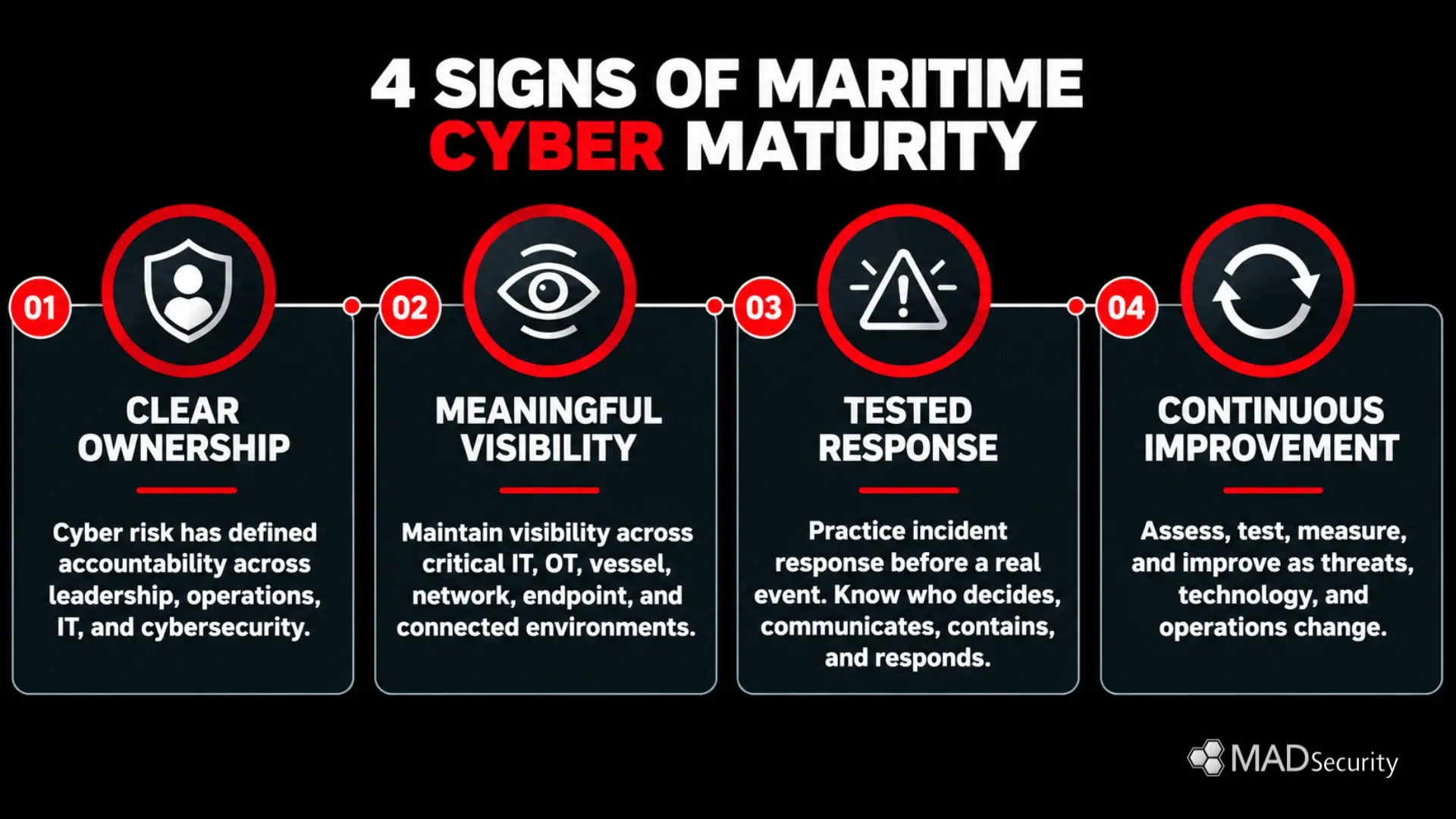
Cybersecurity Has Clear Ownership
Someone needs to own cybersecurity risk and for most maritime organizations, that is the Cybersecurity Officer (CySO).
That sounds obvious, but in practice, responsibility can quickly become fragmented. IT may manage one area, operations another, a third-party provider another, and leadership may assume cybersecurity is being handled somewhere in between.
Mature organizations remove that ambiguity.
Executives understand their responsibilities. Operational leaders understand their goals. Cybersecurity teams have clearly defined roles, escalation procedures, and authority.
The board does not need to understand every technical detail or operate the Security Operations Center. It does need enough information to provide effective oversight and understand how significant maritime cyber risk could affect operations, customers, contractual commitments, regulatory obligations, and the mission.
Clear ownership turns cybersecurity from a technical issue into an accountable business function.
And once accountability is established, the next question becomes whether the organization can see what it needs to protect.
The Organization Has Meaningful Visibility
You cannot protect what you cannot see. Full stop.

For maritime organizations, achieving visibility is challenging. Environments may include corporate IT, vessel systems, operational technology, internet of things technology, networks, endpoints, cloud infrastructure, email, remote connectivity, vendors, and other interconnected systems.
A mature maritime cybersecurity strategy accounts for that complexity and leverages a periodic cybersecurity assessment, conducted both logically and physically, to identify all systems and assets.
Organizations need enough visibility to recognize unusual activity, identify potential threats, and understand when something in the environment requires attention.
This is where effective security operations become critical.
Monitoring alone is not enough. Monitoring needs to support detection, and detection needs to lead to action.
A mature Security Operations Center, or SOC, helps create that connection by continuously monitoring the environment, detecting potential security incidents and anomalies, and supporting an appropriate response.
Visibility gives you the opportunity to act. The next measure of maturity is whether your organization knows what to do when that action becomes necessary.
Incident Response Is Tested, Not Assumed
Most organizations have some form of incident response plan.
The more important question is whether it works, or is even actually used when a bad day happens.
A document sitting in a shared folder does not tell you how the organization will perform when systems are unavailable; information is incomplete, executives need answers, and decisions must be made quickly.
A mature cyber incident response capability answers practical questions before an incident happens.
Who needs to be notified? Who has decision-making authority for shutting down a system or paying ransom? Who can authorize containment? How will the organization communicate if normal systems are unavailable? How will operations continue? When should customers, regulators, insurers, government partners (e.g., Coast Guard), or other stakeholders become involved?
Those decisions are much easier to work through before a crisis.
Regular tabletop exercises and incident response testing give executives, security teams, and operational leaders an opportunity to practice those decisions and identify gaps in a controlled environment.
The goal is not simply to prove that an incident response plan exists.
The goal is to know that your organization can execute it…quickly and confidently.
Even then, maturity does not stop once the plan has been tested. The strongest programs take what they learn and use it to get better.
The Organization Has Meaningful Visibility
Cybersecurity maturity is never finished.
Threats change. Operational drift occurs. Businesses grow. Systems are replaced. New technology is introduced. Vendors change. Regulations evolve. Operational environments become more connected.
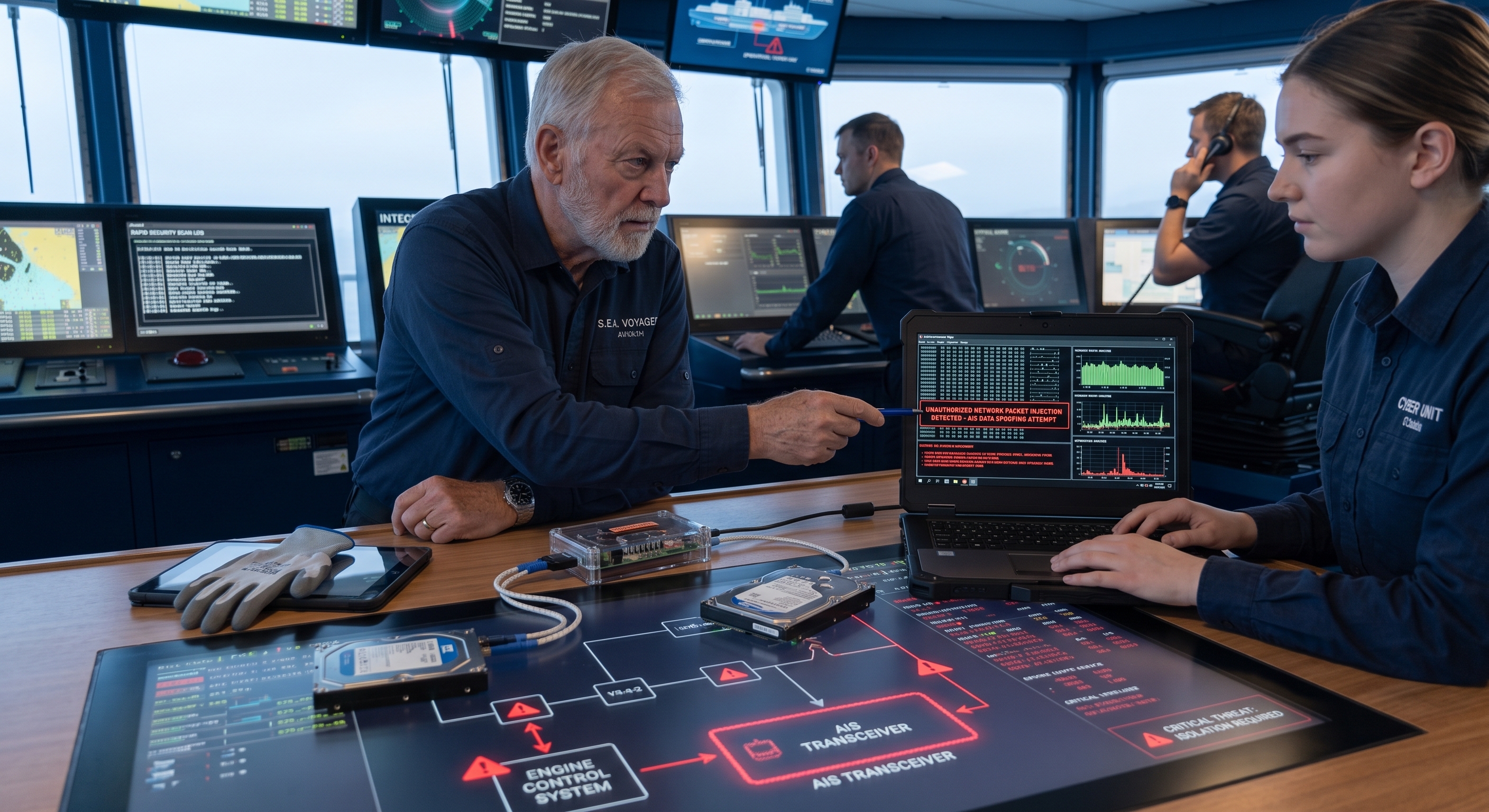 A maritime cybersecurity program that was appropriate several years ago may no longer match the organization’s current risk. Mature organizations recognize this and create a repeatable cycle of assessment, implementation, monitoring, testing, measurement, and improvement.
Frameworks and standards such as those developed by NIST can help provide structure for this process. A NIST-aligned cybersecurity program can help organizations connect governance and risk management with practical security operations and continuous improvement.
The goal is not to reach an imaginary cybersecurity finish line.
It is to understand where you are today, determine where you need to be, and consistently close the gap.
That brings leadership to another important question: how much should the organization invest to make that happen?
Right-Sizing Maritime Cybersecurity Investment
There is no universal cybersecurity budget that works for every maritime organization.
Scale matters, but risk matters more.
A smaller organization that handles sensitive information, relies heavily on critical operational systems, maintains extensive third-party connectivity, or operates under significant contractual and regulatory requirements may require stronger cybersecurity capabilities than a larger organization with a very different risk profile and significantly automated systems.
That is why executives should be cautious about benchmarking cybersecurity investment based only on company size or what another organization is spending.
Instead, leadership should start with operational risk.
What information and systems are most important to the organization? What would happen if they became unavailable? Where are the greatest cyber exposures? What regulatory and contractual requirements apply? How quickly could the organization detect an intrusion? How effectively could it contain and respond to one? When were those assumptions last tested?
Those questions create a much stronger foundation for cybersecurity investment decisions.
They also help prevent organizations from spending heavily in one area while leaving important gaps somewhere else.
The objective is not to spend the most. It is to make deliberate investments that address the risks that matter most.
Governance Matters More Than Technology
One of the clearest indicators of cybersecurity maturity is the way leadership talks about cybersecurity.
In less mature organizations, cybersecurity discussions often revolve around products, vulnerabilities, technical activities, and individual projects.
Those things are important, but executives need a broader view.

In a mature organization, leadership can connect maritime cybersecurity risk to business outcomes. That includes operational continuity, contractual obligations, regulatory requirements, financial exposure, customer confidence, and mission assurance.
This is where strong cybersecurity governance makes a difference.
Governance provides the structure for leadership to understand risk, establish accountability, set priorities, and make informed investment decisions.
Technology remains essential, but it operates within that structure.
The strongest cybersecurity programs bring together governance, people, processes, technology, monitoring, detection, incident response, and continuous improvement into a coordinated operating model.
When those elements work together consistently, cybersecurity becomes more than a collection of projects.
It becomes an organizational capability.
The Executive Standard: Consistency Over Perfection
So, what does “good” maritime cybersecurity actually look like?
| It looks like an organization where cyber risk has clear ownership. | |
| It looks like leadership has complete visibility into the operational and cybersecurity environment. | |
| It means the organization has tested what happens when prevention fails and has pre-defined actions. |
And it means cybersecurity is continuously measured, reviewed, tested, and improved as the organization and its risk environment change.
That will look different from one maritime organization to another, and it should.Cybersecurity maturity is contextual.
A program that is appropriate for one organization may be insufficient for another. In some cases, it may also be unnecessarily complex.
That is why the goal should not be cybersecurity perfection. The goal should be a repeatable, measurable, and risk-based approach to improving cybersecurity maturity and operational resilience.
For executives and boards, the better question is no longer simply, “Are we good enough?”
It is:
Do we understand where we are today, what our greatest risks are, and what we need to improve next?
That is where benchmarking becomes valuable. A cybersecurity maturity assessment gives leadership a clearer baseline for evaluating current capabilities, identifying gaps, and determining whether cybersecurity investments align with actual business and operational risk.
Benchmarking is one of the fastest ways to calibrate expectations and turn cybersecurity uncertainty into a practical improvement plan.
MAD Security helps maritime and government-sector organizations evaluate cybersecurity across people, processes, and technology while connecting security operations, cyber risk management, and NIST-aligned cybersecurity practices into a more complete approach to operational resilience.

Frequently Asked Questions (FAQs)


